
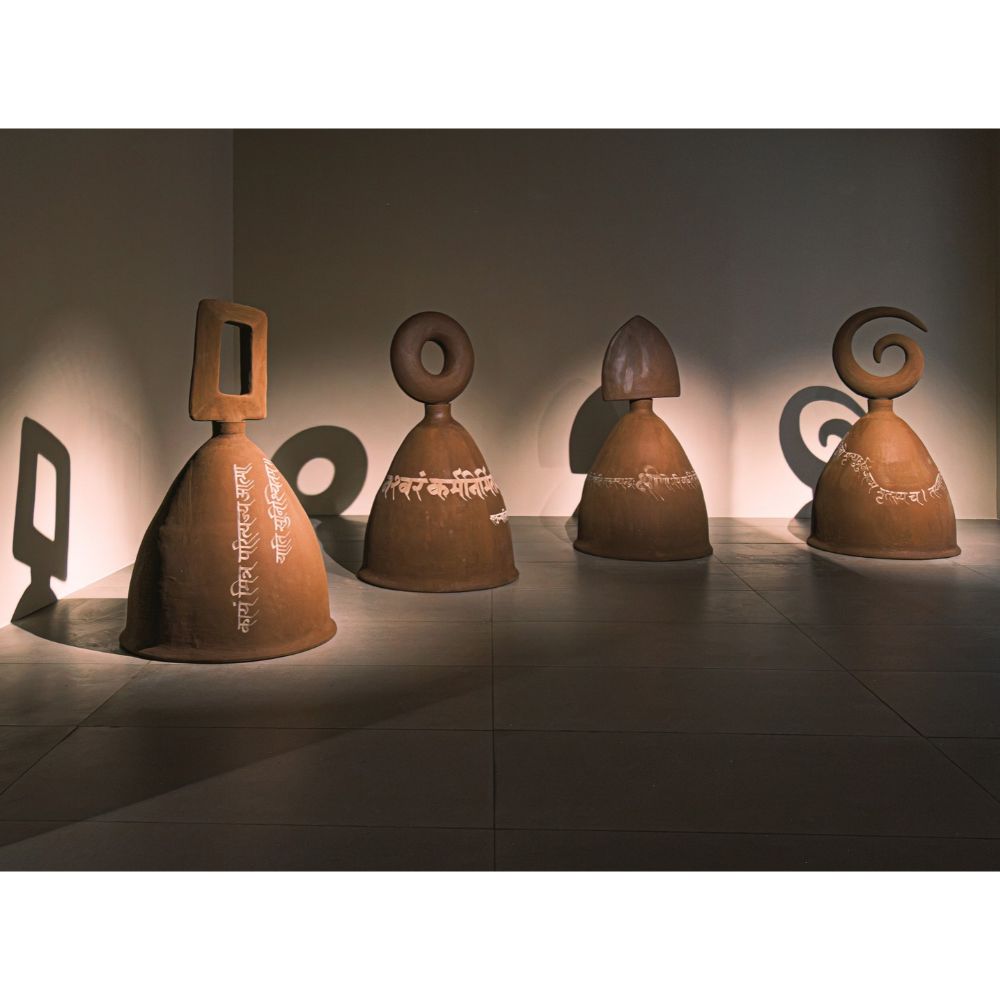
MARKING TIME emerges from Rahul’s continuing preoccupation with the cyclical relationship between life and death, decay and renewal. At its centre is a question that is at once deeply personal and universal: what does it mean to have lived? The body is temporary, memory is frail, objects decay, languages disappear, and yet we continue to create things with the hope that they might outlast us. We make monuments and relics, write texts, and perform rituals as attempts to hold what cannot be held. Rahul’s starting point was an exploration of life and, inevitably, of death itself.
He began looking at some of humanity's oldest sacred and philosophical texts, the Bhagavad Gita, Vedas, Upanishads, Tripitakas, Talmud, Bible and Quran, to consider how different traditions have understood life, its end as we know it, and what may follow. Their languages, cosmologies and interpretations differ profoundly, but he was drawn to a recurring proposition: that existence is not necessarily understood as a linear passage from beginning to end. The body may perish, but something continues; what appears to be an ending may also be a return.
This idea of cyclicality found an unexpected correspondence in clay. Clay begins as earth, is shaped by the hand, altered by water and air, transformed by fire, and eventually returns to the ground. It can hold an impression, a gesture, or an inscription, but it can also crack, break and disappear. Its apparent permanence is therefore always provisional. Clay became for Rahul both material and metaphor, a way of thinking about the body, memory and the passage of time. The exhibition unfolds in two movements: Atman and Brahman. The distinction is not intended as a strict theological proposition, but as one between the intimate and the universal: from the measure of an individual life towards humanity's larger attempts to comprehend existence.
MARKING TIME is therefore not a catalogue of time's passage, but an attempt to inhabit its paradox: what remains, passes, and returns. The works begin with one life, but gradually move beyond the individual towards collective memory, ritual, language, history, and the larger cycles of existence. What survives may be a fragment, a mark, a vessel, a word, a ruin, or simply the memory of having been here.
Perhaps that is all a life can ultimately leave behind: a trace.
And perhaps a trace is enough.
Roobina Karode