
WELCOME TO MOOL
I start with a part of a quote by James Baldwin (1980): “History is not the past. It is the present. We carry our history with us. We are our history…”. This informs how I approach history — the discipline and the feeling. Contemporary history shapes culture, belonging, and home. Anything that we deem threatening to it pushes us to define and defend it for ourselves. That yearning to feel at home, safeguard it, nurture it, and run away from or toward it is the driving force behind MOOL.
MOOL began in 2016 with a conversation between artists Mahwish Chishty and Gunjan Kumar in the USA. They discovered their common ancestral roots of undivided Punjab and conceived The Sindhu Project. It travelled from the South Asia Institute of Art, Chicago (2021), split into two with one half exhibited at Zahoor-ul-Akhlaq Gallery, Lahore (2021-22) and the second at Exhibit320 Gallery, Delhi (2022), reflecting the realities of present-day nation states. As I curated the Delhi iteration, I allowed myself to imagine where this yearning for home could lead us next.
Through the past two years, I have examined, researched, and engaged with this central question, which has now grown to encompass the wider South Asian region. The geopolitical borders of South Asia are contested inheritances of colonial cartographic boundaries drawn carelessly and cruelly by those who barely visited the region. If we look at our shared cultural history, there exists a painful gap between those who drew these borders and those who live its reality. When we attempt to make sense of this reality, this is what it teaches us — whenever collective unrest in the present day articulates its needs, the most important act of every generation before it is to guide, protect, witness, and record. MOOL aims to do exactly that.
This exhibition rests on four thematic strands:
THE COMMUNITY: A collective reference to personal familial archives — ‘family’ defined as inherited, chosen, ancestral, and found. From photographs to personal documentation and recorded oral histories, all of these center womxn and queer ancestries and futures.
THE SOIL: Emotional cartography, where shared land and water are protagonists who have withstood the test of time, and tell us their stories that have been erased in colonial map-making.
THE BODY: The ever-changing body politic, where embedded memories in objects hold up a satirical mirror to our gendered biases and blindspots. Here, we also embrace queer and womxn-led legacies of care, comfort, rest, rage, and rebellion.
THE SCRIPT: The word ‘Mool’ across Hindi, Urdu, Bangla, Tamil, Sanskrit, Sinhala, Assamese, Nepali, Punjabi, and Sindhi and more encompasses ‘foundation’, 'essence', 'original’; a serendipitous cross-pollination of language has occurred which conveys finding home across lands, rivers, and time.
Pivoting the premise from thinking towards feeling remains the exhibition's biggest triumph and challenge. Hence, MOOL asked its artists, aged 80 to 30years old, What makes you feel at home and why? For Arpita Akhanda, it is her grandparents' ancestral roots in Sreekail and Faridpur in undivided Bengal. For Ashfika Rahman, it is the multi-faith community ownership of the intangible heritage of the Sundarbans in the face of intolerance. For Ashmina Ranjit, it is the ability of the female body to birth life and endure chastisement for the same while resisting intersectional social differences around Kathmandu. For Bunu Dhungana, it is in gendered experiences and how the conversation between mothers and daughters continues. For Chathuri Nissansala, it is honouring their queer ancestry in the land which denies its existence. For Chudamani Clowes, it is the distinct discomfort of decolonising histories in the diaspora. For Deena Pindoria, it is the evolving knowledge, memory, and migration of Ajrakh textile makers spread across Kutch and Sindh. For Gunjan Chawla Kumar, it is the handmade charcoal soot used for mark-making as a precursor of the undeciphered Harappan script. For Hema Shironi, it is how her embroidery documents homes that have been forcefully erased in Sri Lankan cities. For Mahwish Chishty, it is the larger-than-life renditions that make artefacts from the Harappan region accessible to those who cannot visit it. For Mariam Suhail, it is the intentional, deliberate strokes of ink that sharpen what gets missed in translation. For Naira Mushtaq, it is painting collective familial photo studio memories which invite all types of belonging. For Nilima Sheikh, it is in finding, carrying, and leaving behind homes across time, from permanence to transience. For Reena Saini Kallat, it is the familial histories rooted in undivided Punjab which foreground erased and uncomfortable histories, while revealing overlooked connections across political and cultural boundaries—with an invitation toward solidarity and collective healing. For Riya Chandwani, it is in honouring the oral histories and Sindhi folklore her grandparents carried in their forced departure. For Sheelasha Rajbhandari, it is about acknowledging the labor, silence, and outrage of women and fluid ancestors and comrades, while trying to accept rest as a radical act of resistance. For Tayeba Begum Lipi, it is the gendered treatment of the body, and that which adorns it and hides it at the same time. For Wahida Ahmed, it is the lived reality of Assamese womanhood with cultural heritage of indigeneity, and of faith. For Yasmin Jahan Nupur, water, script, and textile are the protagonists that bear witness to the ecological crisis through Chattogram and Dhaka. For Zarina, it is “wherever the people you care about the most are waiting for you”
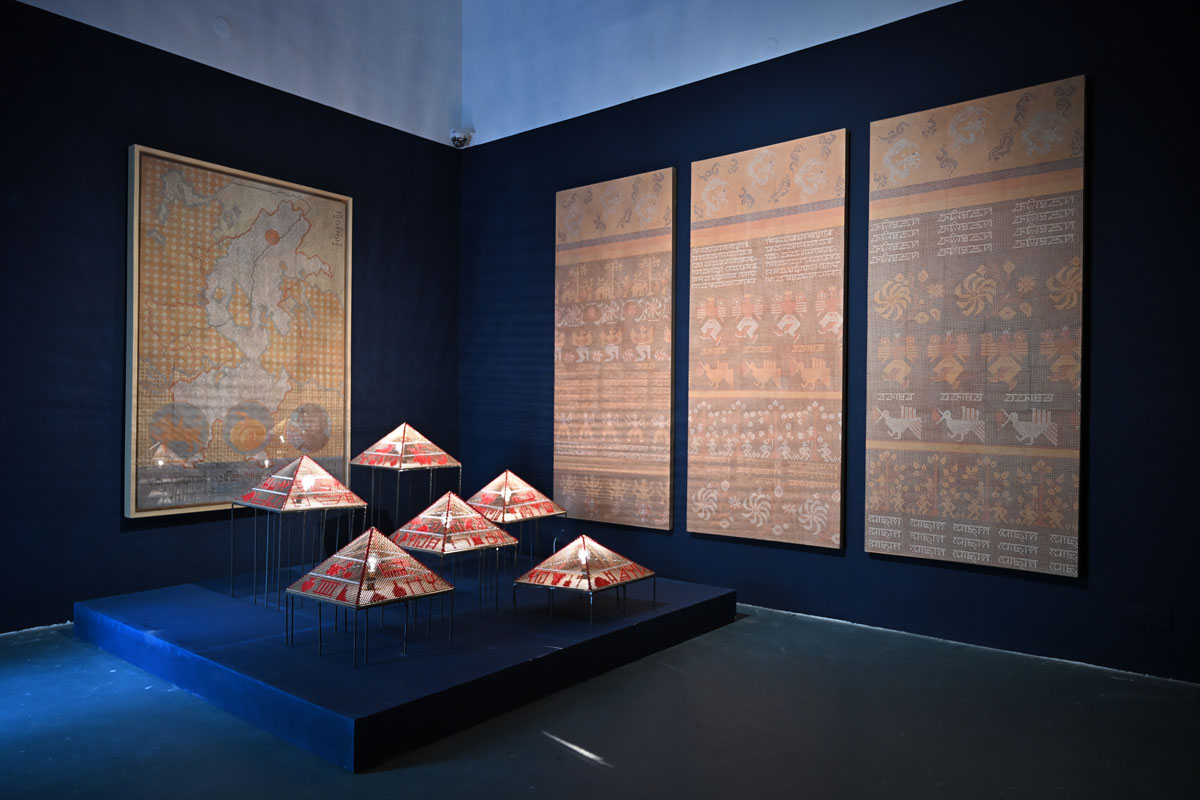
The beating heart of the exhibition is the personal artefacts of the artists’ families you see on your right. Showcased in a public setting for the first time, these invaluable objects represent a sense of belonging when the artists thought of ‘home’. As you stand with these personal histories, ask yourself: what makes you feel at home? And why? Maybe the answer changes as you leave this exhibition.
I am a granddaughter of a lineage that fled war-torn Rangoon to present-day India in 1941. That has left its own indelible mark on me—that all histories are not known equally. Places we call home today, were unknown futures for those that sought refuge then and continue to do so now.The full quote of James Baldwin was “History is not the past. It is the present. We carry our history with us. We are our history. If we pretend otherwise, we are literally criminals”.
No one exhibition can showcase the length, breadth, and depth of what belonging means to a region as diverse as South Asia. Instead of reclaiming this definition, which presupposes that agency was 'taken', the focus of this exhibition is to recognise that this region always had its own documented and lived histories of language, art, culture, history, and heritage. Whilst we do that, it is also crucial to be aware of whose histories are not being documented, whose stories are not being told, and who cannot go back to their homes. The reality of this region must acknowledge that artworks are meeting where artists cannot. As long as we remember that there is no definition of ‘we’ in this politics of identities, the capacity for pluralistic, nuanced thought can prevail. This is the defining testament to the diversity of this region. In times as divisive as ours, where truth escapes into repressed silences across time, MOOL aims to hold our contemporary time accountable to its history, to its present, and to its future, through you. The viewer.
Shaleen Wadhwana