
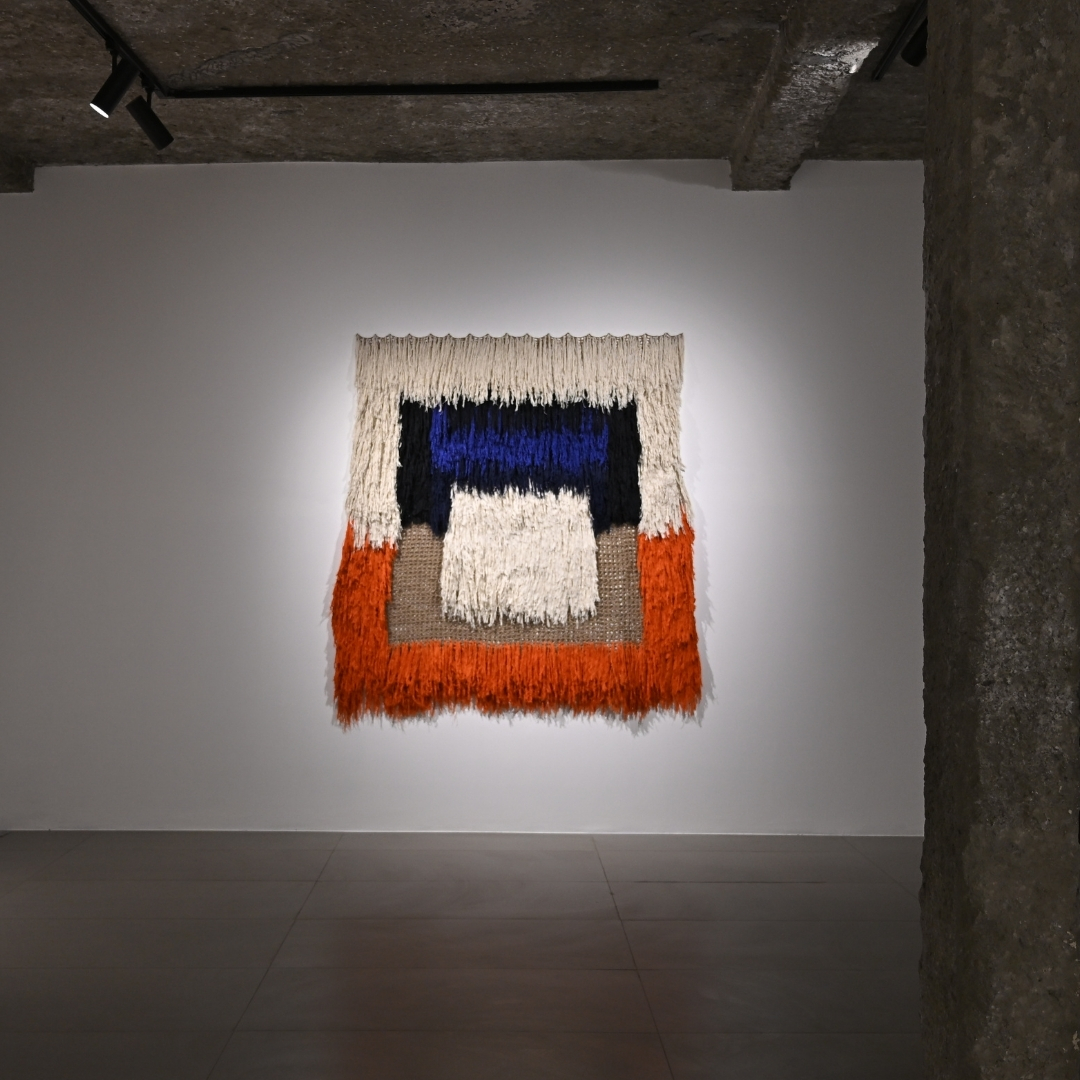
The exhibition brings together seven artists working across digital form, textile, paper burn, sculpture, and collage. At its centre is the idea that the act of making is itself an insistence — an assertion that what has been lived, felt, and inherited carries histories beyond the written record. The exhibition in turn invites viewers to reckon with the works: to read within them what constitutes cultural memory.
Emerging from a word, the curatorial enquiry moves closer to a disposition than a subject. Insisting holds within it a particular quality of attention that is sustained, inward, resistant to resolution. The process of threading the practices together was also a process of locating where the word is held, where it resides, and how it may condition the viewer's eye. Each artist speaks through the same impulse, an elemental language of symbols, motifs, and materials.
Moving through the exhibition are distinct yet overlapping concerns, expressed in different ways: migration and its emotional residue, the knowledge stitched in ceremonial fabric, the authority embedded in structures of education, the colonial histories folded into textile traditions… What is shared is the method, a refusal of direct statement in favour of something slower, more accumulated.
The insistence stems from a place of emotions, from the particular friction of being asked to move within systems that do not move for you. Emotions are not only felt mentally; they are physical, residual, and transferable, shared across bodies and generations. The works here are understood as responses to that friction, to the social norms and structures we are expected to inhabit, structures that were never built with everyone in mind. What distinguishes these responses is that they are mediated rather than immediate. The artists do not react; they remain deeply invested in what they turn their attention to.
“The making of a work of art is one historical process among other acts, events and structures - it is a series of actions in but also on history. It may become intelligible only within the context of given and imposed structures of meaning; but in its turn it can alter and at times disrupt these structures... a work of art may have ideology as its material, but it works that material.” (T.J. Clark, Image of the People (Princeton University Press, 1982), p. 253.)
It is this working of material that becomes most legible here — in the rewriting, the reflecting, the questioning of how knowledge is made and kept. In challenging or eluding the authority of linear interpretation, the works invent alternative modes of narration, modes that might be understood as individual languages, as autobiography, or simply as a different way of knowing.
Quiet and durational, each individual expression is directed beyond confrontation, turning inward, toward what one cannot stop caring for. The methods become shared grammars of repetition, inheritance, and the slow labour of making — through stitch and familial object, through technology and tracing. Each practice insists on its own terms, and in doing so places a gentle but serious demand on the viewer: not simply to observe, but to reckon. To remain with what is being held out, and to recognise what it carries.